Wednesday, April 3, 2013

dei Frescobaldi South Beach, Miami a mecca for wine & food aficionados

Story and photo gallery by Dwight Casimere

SOUTH BEACH, Miami Beach--A 700 year old Italian wine legend from Tuscany has lent its name to an ambitious culinary effort, which promises to be a mecca for lovers of great wine and expressive, modern Italian cuisine.  dei Frescobaldi Ristoriante, Wine Bar and Lounge, in the Hotel Astor, at the corner of Washington & 10th in DSouth Beach, dominates the garden area, part of the expansive lobby level and a cavernous lower level dining space to create an ideal environment for the appreciation of gastronomy.

Greeted by affable host Piero Benini, the excellent appointments within the ultra-chic modern art deco environment, are evident. Gleaming white furnishings are offset with exposed floor to ceiling wine rack displays and carefully positioned pieces of modern art and alcoves with a plethora of rare celebrity photo prints and carefully scattered art deco pieces. Just as the restaurant is visually pleasing to the eye, the menu and wine list are equally appealing to the palate, with a copious mix of Italian and modern American fusion specialties designed to enhance the experience of sampling a wine list that heightens the wine tasting and fine dining experience.

"The menu is a mixture of Italian peasant food and high cuisine," said General Manager Benini. "Our chef really likes to blend Old World standards with a modern twist of interpretation. We use fresh local ingredients to heighten the flavor experience, because our emphasis here is the marriage of wine and food. In this way, we hope to bring out the best qualities of both."

dei Frescobaldi Miami Beach is based on the concept of the original restaurant in Florence, where casual elegance is the key. Located in the heart of this historic city, just off the Piazza della Signoria, the restaurant is noted for, not only its outstanding cuisine, and wine list, largely representing the wines of the one of the region's founding families, but the level of service.  "Where the customer is treat like a king!" is the motto of the restaurant.  Additional versions of dei Frescobaldi are located in Rome,m where there are three locations, and in London, where the restaurant is located within the confines of the historic Harrod's department store.

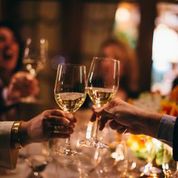
Dining at dei Frescobaldi is like a celebration, so it was appropriate to start with the Danzante Prosecco Spumante Extra Dry ($20). This parkling wine has a delicate mousse, with intense flavors of fruit and the fragrance of delicate white flowers, apples and pears.

The first course was one of the restaurant's signature dishes and a Florentine favorite; a warm composed salad of grilled octopus, squid and cuttlefish with a white ragout risotto. It was paired with Danzante Pinto Grigio  ($18) It was the first white wine offered and, because of its bright citrus nose and distinct layers of white peaches and crisp green apples on the palate, it was a wine that would make encore appearances throughout the meal, which was dominated by the most exquisite fresh seafood ever.

dei Ferscobaldi is famous for its fresh homemade pasta and the chef in Miami Beach did not disappoint with Taglioni, a thin fettucini noodle with black truffles and butter, again with the Danzante Pinto Grigio. This is a clear example of how simple is always better. One could smell the rich, earthy aromatic truffles almost as soon as the dish exited the kitchen. The delicate noodles seemed to disappear on the palate, allowing the rich, umami feel and flavor of the butter truffle sauce to linger in the mouth. Abondanza!

The wine list at dei Frescobaldi is, of course, dominated by the great wines of the Fescobaldi family. There are some real treasures here, like the Mormoretto 2006 Toscana ($56) or the Nipozzano Riserva 2005 ($65) Chianti Rufina. These are wines perfectly suited for what would have been my next course, had there been any room, the sliced Bisteca alla Florentine with black truffles. Next time! and, based on my experience, there certainly will be.

I finished the meal with the restaurant's signature Lily cappucino and a magnificent tiramisu the best I've ever had. This one is the real deal. Every tiramisu  I've had anywhere else was a mere pretender!


Sunday, March 31, 2013

Amarone wine; the Ruby-red jewel of Valpolicella

Story and photos by Dwight Casimere

VERONA, ITALY--The last gasps of winter give way to the gentle breezes of spring in the foothills surrounding this most romantic of cities, with its ancient palaces,  busts of past Kings, the statue of Dante, and likenesses of William Shakespeare, who created the beloved story of Romeo and Juliet, set in this jewel-box of a walled Renaissance city.

Less than an hours' drive from the historic Arena, where our press bus departed from the front of the adjoining Gran Guardia Palace, are some of the most lush vineyards in all of northern Italy. Amarone wine is the Ruby-red jewel of the region, and among the most prized of all red wines, with its rich history and unique flavor profile. It is so because of the intense character of the grapes, grown in the mineral-rich soils that also produce some of the finest marble in all of Italy. The rolling hills are dominated almost everywhere by vineyards, which are cultivated mostly in the "pergola" style, creating a landscape that is artistic to the eye.

The geological history of the land dates back to the Mesozoic period, which lasted about 150 million years, in which the mountains you now see were completely submerged under the sea. To this day, one can see traces of prehistoric shellfish in the crumbled earth. The richness of these fossil remains inform the soil compounds and enrich the quality and flavor of the grapes.

The harvesting of the grapes for Amarone in mid to late September, also adds to the richness of the resulting wine's character. The subsequent grape drying process, or "passito" turns out to be the single most distinctive feature of the vintage. The grapes are laid out in plastic bins (earlier wooden racks were prone to fungi and are no longer in use), and held in drying rooms kept at a constant humidity under optimal conditions. The grapes are then pressed and the juice fermented.

 After the fulfillment of malolactic fermentation, aging is carried out in both small and large barrels and then blended according to the preference of the master winemaker in order to give prominence to the wines' fruity notes of red and ripe black fruit and the distinctive back notes of bright tannins and beautifully rounded baking spices from wood aging.  Amarone, with its unique blend of ripe fruit, jam, spice and bracing balsamic effects is one of the taste treasures of the wine world. It is uniquely suitable for a variety of cuisines, with its bracing fruit and acidity and its strong tastes and rich aromas. Game meats, cured sausages and salumi, the delightful arrady of both raw and cured hams and the vast array of cheeses that characterize the cuisine of the Valpolicella, are uniquely suited to Amarone wine.

Visits to a quartet of contrasting wineries in a single day showed the true varietal breadth of Amarone, from the refined vintages of Ca' Rugate and the elegant style of  winemaker Michele Tessari in their high-tech facility, to the more rustic, jammy Amarone wines of Dal Bosco Giulietta "Le Guaite" and winemaker Roberrto Vassanelli, who prepared, with his lovely wife, a sumptuous rustic  repast of freshly cured and sliced meats (which this reporter attempted to replicated on their ancient slicer, to humorous effect!) in their hunting lodge of a tasting room with taxidermy all around. The grand finale to the meal was a spectacular Tiramisu prepared by Mrs. Vassanelli which was the best I've ever had!

This is Amarone in all its many facets and flavors.  The wines of this delightful region are readily available in your local wineshop or market. All you have to do is ask your local proprietor to direct you to them. If he has any familiarity with Amarone and the wines of the Valpolicella, he or she will direct you to them with delight!


Spain's first "Zero Carbon" wines make U.S. debut!


Eccoci creates wines that please the environment and the palate
Story and photos by Dwight Casimere
NEW YORK--The distance between  the foothills of Spain outside Barcelona and trendy Tribeca got a loittle shorter this early pre-spring evening, when winemaker Manuel Lardeux arrived at Tribeca Terroir for an evening of Tapas & Vino to unveil Spain's first ever Zero Carbon wine, Eccoci Wine, to an intimate gathering of wine writers and buyers. The evening included a delicious array of Spanish tapas, or small bites, typical of northeaster  Spain. The evening quickly escalated from an informal tasting to a full-fledged dinner and in-depth discussion of the actual impact of responsible ecological practices on winemaking and its ultimate effect on what's in the glass.

"My family actually came to Spain from France," Lardeux offered over a heaping plate of grilled sardines dressed in garlic and olive oil andd served with the first wine to be introduced, Eccoci Rosado 2011 ($22.99), a crisp, very faintly pink rose' wine made from 100% Petit Verdot grapes from the winery's Cain Nobas parcels, which adjoin a river, where the soil is rich with limestone and alluvial stones.

"We came to the idea of producing environmentally wines quite naturally," he emphasized. "Our property is right next to Les Gaverres, a nature preserve, so it just makes sense to conduct our business in away that doesn't have a negative impact on our surroundings."

Leroux says, besides minimizing the impact of the winery's carbon footprint, by utilizing environmental best practices, the winery also purchases carbon credits to offset it's footprint.
"I even took into account the carbon impact of the flight I took here to New York in deciding which airline to take!" further emphasizing the point.
I forwent the rest of the assorted salumi and other appetizers and went directly into a tasting of the other wines. 

Eccoci Super Premium Red 2009 ($47.99) was the star of the show. A big, robust red wine that still maintains a refined elegance and lucious dark and red fruit blend of flavors is made with that Catalonian marvel, 100% Marseian grapes. The grapes for the wine are all hand harvested and the grape juice is all derived through gentle bladder pressing using gravity flow (more energy and environmentally responsible methods!) The wine is then allowed to rest on the lees (the dead bacteria from the fermenting yeast) to enrich its flavor and body. It is then allowed to age in merrain oak barrels, which are lightly toasted to give the wine a well incorporated back note of hints of Tahitian vanilla, crystallized ginger and a hint of cedar closet that gives it rich fruity flavor with oak that is fully integrated into the overall taste.

Working backwards, I then tasted the Premium Red 2008 ($33.99) This was another outstanding wine, whose richness far outweighs its modest price. Of the two, this I found to be the more food-friendly wine, with the tannins backed off and somewhat mellow. Again, the grapes were harvested by hand and processed by gravity flow. The wine was aged for just three months in merrain oak, giving more emphasis to the fruit by utilizing the oak simply as a means of "resting" the wine and letting it mellow out. Mission accomplished!
I left the Eccoci Bianco (white wine-$21.99) for last as a sort of palate cleanser. That proved to be a misnomer! The wine was a rich, mouth-filling blend. "The wine is made from  grapes from our Ca l'Elsa parcels," Lardeux offered. "The vineyards lay at the foot of an inactive volcano where the soil is rich with limestone and volcanic soil. It has very good drainage, so the grapes have to struggle somewhat, and that gives them a rich concentration of flavor."
The blend, 50% Rousanne, 30% Viognier and 20% Manseng is more akin to something you'd find in the Loire vallley of France than the Pyranees of Spain, but, no matter, the resulting wine is delightful by any nationality! Vive Le France! Mucho Gusto, Spain! 


The scene at Tribeca Terroir; a night of  Tapas& Vino with Eccoci wine manager Manuel Lardeux


Wednesday, March 20, 2013

Frescobaldi Wine a Centerpiece at Night of Italian Stars in Bel Air


Frescobaldi wine shines in Italian Michelin star Chef's galaxy of cuisine

Story by Dwight Casimere
 Actor and filmmaker Sylvester Stallone confers with chef Bottura
 Members of chef Bottura's team from Osteria Francescana in Modena,Italy
 Marchesi de' Fresobaldi Castelgiocondo Brunello di Montelcino with chef Bottura's Veal Sous Vide
 Chef Bottura's Risotto cacio a pepe
 Only 28 lucky diners got to participate in the exclusive dinner
 Chef Bottura's "killer" tiramisu
exclusive photos by Federica Valabrega


A Michelin starred chef, considered to be the best in Italy, an Italian American superstar filmmaker and action hero, and an historic Italian wine of unparalleled quality and prestige, those were the marque elements of a fantastic dinner event that took place in Los Angeles as part of the Italian government's "Year of Italian Culture, marking 2013 as a showcase of Italian culture, art, music, fashion and science, among other areas of distinction.

The chef; Massimo Bottura of Osteria Francescana in Modena, winner of three French Michelin stars and ranked number five in last year's Best Restaurants list, sponsored by S. Pellegrino and Acqua Panna, making him the highest ranking Italian chef. The super star; Sylvester Stallone,the American filmmaker, actor and screenwriter, whose father was born in Gioia del Colle, in Apulia, Italy, and who is a proud exponent of his Italian American heritage, and appeared at the Bel Air dinner exclusively. The wine; Marchesi de' Frescobaldi Castelgiocondo Brunello di Montalcino, from one of the oldest and most esteemed winemakers in all of Tuscany. 

The Frescobaldi wine was the centerpiece of an amazing multi-course dinner prepared by chef Bottura and his team, based on the theme "Come to Italy with us." The dinner was presented in three cities, New York, Washington, D.C. and Los Angeles. Frescobaldi's Castelgiocondo Brunello di Montalcino 2008 was paired with an amazing main course, in which chef Bottura incorporated the wine as one of the key ingredients. Veal sous vide (a slow cooking method in which food is sealed in an airtight plastic bag and cooked in a water bath for up to 72 hours), which was "painted" with the colors of the Italian flag; the red was made with a reduction of the Brunello wine, the white was a potato puree and the green was composed of simple chlorophyll. Chef Bottura's pairing with the veal was spot-on. The firm acidity of the wine married perfectly with the rich taste of the veal. The wine's complex flavors of dark berries, rich dark earth, dried oregano, truffles and back notes of dark chocolate and cedar and a hint of tobacco on the palate made this a seamless pairing.

Other dishes and wines included Donnafugata's Passito di Pantelleria from Sicily, paired with a killer tiramisu and Franciacorta Berlucchi '61, a sparking wine, paired with Bottura's signature Risotto cacio a pepe, his response to the May 2012 earthquakes in Emilia, in which 400,000 huge wheels of Parmigiano Reggiano cheese were destroyed. Chef Bottura simmered the Vialone Nano rice in Parmigiano broth, making an exquisite reduction, in which each grain of rice was infused with the flavor of the Parmigiano cheese. It was a masterpiece of achievement, creating a creamy, flavorful risotto without the use of cream, butter or any other butterfat except what was derived from the cheese; a fitting tribute to the indigenous cheese industry of Emilia Romagna!