Thursday, March 10, 2011

Miami International Film Festval: Day Six


1. Amador film star Magaly Solier with Director Fernando Leon de Aranoa at the Paella Parade
2. Chef Luis Quant of Por Fin Restaurant & Lounge, Coral Gables, Florida, and his award-winning Fresh Quail Paella
3. Chef Fonseca's Fresh Seafood Paella from El Carajo International Tapas & Wines, Miami
4. Staging area for Garcia's Seafood Grille & Fish Market Seafood Paella
5. El Coto de Rioja wine display at Miami Beach Botanical Gardens
6. Partygoers enjoy a glass of El Coto de Rioja Tempranillo wine
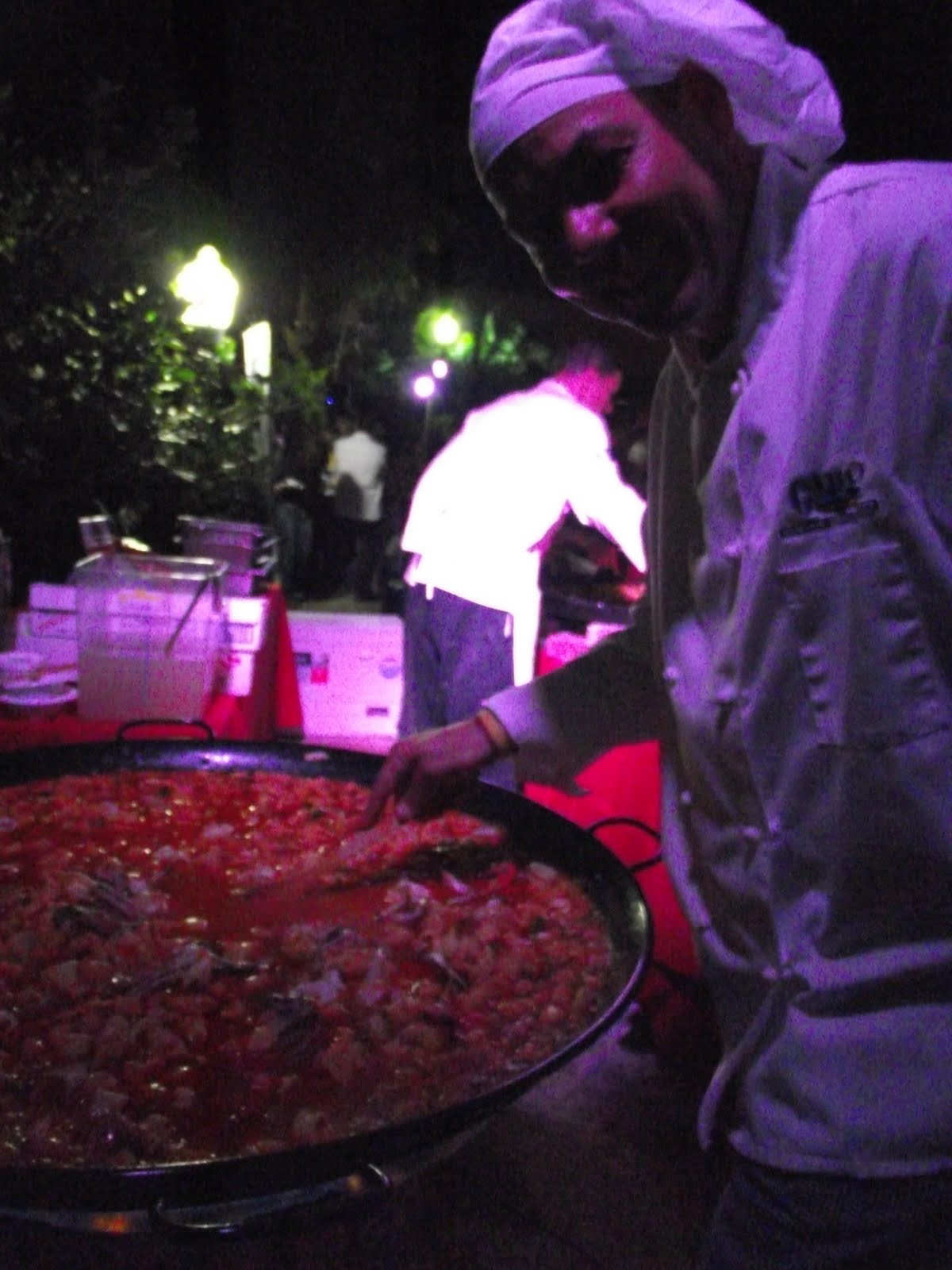
7. Chef Steve Garcia at the Paella Pan
8. Flowers were the central theme of the film, Amador, and the centerpiece of the Paella Parade at Miami Beach Botanical Gardens
9. Chef Garcia's Seafood Paella
10. Dwight The Wine Doctor tries his hand at Seafood Paella with Chef Steve Garcia


Amador: North American Premiere examines estrangement and the afterlife with a touch of Saffron and Rioja

Story and photos by Dwight Casimere

SOUTH BEACH, MIAMI BEACH, FLORIDA—Amador, the Spanish-language film (with English subtitles) from Spain, in its North American Premiere, was the centerpiece of a night dedicated to the food, wine and moral and ethical sensibilities of Spanish culture. Amador is in World Competition at the festival.

The film, a sixth outing for the award-winning Madrid-based screenwriter and director, Fernando Leon de Aranoa, who last appeared at the Miami Film Festival seven years ago with his film Princesses (Princesas). Amador examines the issues of loneliness, prejudices regarding immigration, and emotional attachment to departed loved ones, in this case, bordering on necrophilia. Add to the mix the overlay of a thematic story line that follows the arc of the life and death of flowers and their relation to human life and death and intimations of the after-life and you have the threads that director Leon weaves into the rich tapestry of this film.

The cinematographer immediately introduces us to the bleak landscape of suburban Madrid and the sub-culture of its immigrant flower merchants. He provides the perfect tableau for the ensuing moral drama to unfold. The pacing and the dialogue by Leon, who also co-wrote the script, are masterful, but it is the luminous actress Magaly Solier, whom I recognized from the Academy Award-nominated Peruvian film, “The Milk of Sorrow (La feta asustrada), who really knocks this film out of the cinematic park. If there were ever an Oscar for the pure art of acting, Solier would be the winner. She conveys more with a mere look; the quiver of a cheek, the arch of an eyebrow, a Mona Lisa-like smile, that conveys more meaning than all the words of Shakespeare.

As the impoverished immigrant, Marcela, she struggles to find some emotional connection to the world around her. There seems to be no relief from her overriding sense of loneliness and emotional abandonment.

In the film, she is seen living with her lout of a boyfriend, Ernesto, who only sees her as a sex object and a foil for his illegal business of selling stolen flowers in the streets of Madrid. He could get a normal job, but he refuses to. He’d much rather hang out with his cadre of street scum and chase his wild, and unproductive dreams.

Early in the film, Marcela learns that she is pregnant, but is afraid to tell him, because she is sure he will leave if he finds out. In order to bring some much-needed cash into the household and help her boyfriend pursue his misguided dream of expanding his flower business, she takes a job as caretaker to a dying man. The low-paying job is typical of those to which immigrant workers are relagated. She is payed a barely liveable wage under the table by the vainglorious Teresa, who could care less about her dying father, Amador.

Marcela grows attached to the taciturn old man and their platonic relationship deepens as they both express their loneliness. Each in their own way makes a vain attempt at finding meaning in a world that always seems to exist just beyond their grasp. Amador spends hours putting together the pieces of a puzzle as a distraction from his bedridden tedium. The puzzle becomes a metaphor for Marcela’s disjointed life and shattered relationship. (“In life, you are alone,” she says. “So you try to find someone to be with. But it stays the same. In the end, you are still alone!”)

The old man surmises that she is pregnant and asks to touch her swollen belly. He offers a half-hearted prayer. Speaking aloud to the unborn infant, he assures her child that there will be a place for him in this world. “You can take mine. I will save a place for you,” he declares. It is a touching moment.

Marcela demands that Teresa pay her in advance so she can put a down payment on the refrigerator her boyfriend wants to store flowers for his business. He calls the business “Marcela’s Flowers” and places multi-colored refrigerator magnet letters on the door that read “Floris Marcella.” Instead of delighting her, the garish display drives a knife through Marcela’s heart and makes her feel even more alone and unappreciated.

Just as things appear to be going along swimmingly, the old man dies. Marcela is in a quandary. Should she tell Teresa her father is dead and lose all of the money she so desperately needs? More importantly, should she give up the one relationship and emotional sanctuary, that has given meaning to her desolate life.

In the course of her dilemma, she seeks counsel from two disparate sources; her priest, who inadvertently convinces her to continue the deception, in the film’s most wildly hilarious scene, and from an aging hooker, who pays weekly conjugal visits to the old man.

Amador is a touching film that applies gentle humor to some touchy and uncomfortable subjects. It offers a new perspective on sudden death and belief in the afterlife and affirms the enduring power of love.

“I wanted someone who was really an outsider,” director Leon said in his post-screening comments, in which he appeared with the actress Solier at his side. “The character Marcela is from Ecuador or Chile, we never make it quite specific. But the important point is that she is estranged and feels somewhat detached from her immediate environment. We see it even more with her relationship with her boyfriend. Then, the point is really driven home when Amador dies. Her relationship with Amador turns out to be the only real anchor in her life.”

Later, the director and star segued with the entire audience to the Miami Beach Botanical Gardens for the Paella Parade, presented by El Coto de Rioja, the premium Spanish wine maker.

Presenting their outstanding wines, including El Coto Rosado, a refreshing Salmon-colored blush wine made from the perfect combination of 50% Granacha and 50% Tempranillo, the native premium grapes of Spain, El Coto Crianza, a Reserve wine made with 100% Tempranillo grapes that is aged 14 months in new American oak casks, and El Coto Blanco, a refreshing white wine made from 100% Viura grapes, another native varietal from Spain, which is fermented in stainless steel tanks to preserve its freshness and crispness.

The main event of the after-party was a parade of the most delicious Paellas imaginable, from the best chefs and restaurants Miami has to offer. Paella is a traditional rice casserole, prepared in a huge round, shallow pan with saffron rice, herbs and a hearty mixture of seafood, poultry and Spanish cured meats. The flavorings and varieties are left to the whim of the chef and each Paella experience is different. There was a contest to choose the most imaginative and delicious Paella. My personal favorites were the Quail Paella from Por Fin Restaurant & Lounge, which featured copious bits of fresh quail and was topped with raw quail eggs and fresh cilantro and the savory Seafood Paella created by Chef Steve Garcia of Garcia’s of Miami.

Over a dish of marvelous seafood Paella from El Carajo International Tapas & Wines, director Leon and actress Solier took time to share their thoughts on the film. “What I like about Magaly,” Leon said, referring to his lead actress, “is her ability to express so many emotions. Her face is like a diamond that catches the light in so many different ways. She is a powerful actress, yet she is still very subtle in that way.”

The evening was a combination of art from the cask, and from the culinary and cinematic arts. It made for the perfect blend for Dwight The Wine Doctor!

Wednesday, March 9, 2011

Welcome to the Wines of Ribera 2011. Drink Ribera! Drink Spain!


Story and photos by Dwight Casimere

MIAMI—The Contemporary Art setting of Rubell Family Collection, an eclectic converted warehouse that is a design studio and showcase for monument-sized sculptural art in Miami’s Design District, was the setting for the U.S. Premiere tasting of the Wines of Ribera in Spain. Drink Ribera. Drink Spain, the Grand Tasting 2011 is the landmark event of the Spanish wine industry in America.

Ribera del Duero provides a benchmark for quality in the Spanish wine category. The wines represent the pinnacle of Spanish winemaking and the ultimate expression of Spain’s most noble grape: Tempranillo. Located in Spain’s storied northern plateau an hour and a half north of Madrid, the Ribera, or “River Bank” in Spanish, encompasses four provinces, Castilla y Leon, Burgos, Segovia, Soria and Valladolid. The Ribera region flows along both sides of the Duero River Valley. The wines, rich and complex, benefit from the great diversity of soils deposited by the river.

Officially founded as a designation in 1982, the region and the families that own the wineries actually have a history that dates to antiquity. Winemaking in the Ribera goes back over 2,000 years to the Roman era as evidenced by a recent find, a huge mosaic of Bacchus, the God of Wine, unearthed at Banos de Valdearados. Benedictine monks settled in the area from Burgundy in the 12th century and revived the art of winemaking in the region. At the height of the Spanish Empire in the 17th & 18th centuries, Ribera wines were the most highly prized of Spanish exports. Today, new technology is melded with a respect for tradition to create wines that have garnered international acclaim.

At the Miami tasting, the wines showed beautifully. Each had unique character. It’s amazing how the same grape variety grown in different soil conditions and with the distinct artistry of the winemaker, many of whom are women, can produce profoundly different tasting wines. While only a handful of the wines are available currently, the number of ‘heavyweight’ distributors, both locally and nationally, represented at the tasting, ensures that the wines will be on shelves in your favorite wine store by the start of Spring. Another strong indicator that speaks well for the reception of Wines of the Ribera is the ratio of price to quality. The most expensive wines in the room will retail for $29. A comparable French or California wine would easily cost $100. Most of the wines are in the $12-$20 price category, a very comfortable price point in these fuel cost-ravaged times.

The catering staff at the Rubell Collection provided a variety of Spanish influenced ‘Tapas’ including the marvelous Serrano Ham, spicy cured cold meats, such as Chorizo, Lorno and Salchichon, Machego Cheese, and a delicious Spanish Frittata, a traditional Spanish omelet made with herbs (parsley & thyme), minced garlic, thinly sliced onions, mild grated cheese and slices of cooked potatoes. Accompanied by a light, slightly spicy wine, such as Bodegas y Venedos Ortega Fournier 2008 Urban Ribera ($12.50), a wine that is readily available at most wine shops in the U.S., this is a lunch or early dinner dish that is sure to satisfy. It’s long on flavor and short on calories and is perfect for spring!

Back in my sailing days, when I lived in Sausalito in the San Francisco Bay Area, I hung out with a number of Spanish transplants that loved to prepare lunch for an outing on the open Bay. One of their favorite potluck dishes was a delicious Frittata. I managed to get the recipe from my old friend, Joaquin. Here’s his recipe for Spanish Frittata (traditional Spanish omelet) as I remember it.

Ingredients and things you’ll need:

¼ cup olive oil (NOT virgin olive oil)

1 medium onion

4 eggs

1 medium potato

1 tsp chopped garlic (1 clove)

¼ cup fresh parsley (do not used dried, it won’t taste right)

1 tsp minced fresh thyme (again, FRESH is essential to the taste)

½ small red bell pepper

Salt and pepper to taste (I prefer grated mixed peppercorns or white pepper)

½ cup grated firm white cheese (Machego, a Spanish white cheddar-type cheese made from Sheep’s milk, available at most fine food stores or gourmet cheese sections at your local supermarket. You can use Asiago or Parmesan in a pinch, but, again, the authenticity and the taste won’t be the same).

Cooking Instructions:

  1. Slice onion and bell pepper into thin strips. Set aside.
  2. Mince garlic, parsley and thyme and grate the cheese, if it isn’t already.
  3. Peel the potatoes and cut them in half lengthwise, then slice them into thin half-moons that are the thickness of a nickel.
  4. Heat oven to 325 degrees
  5. Heat and ovenproof, nonstick skillet over medium heat and add 1 tbsp olive oil
  6. Sauté the garlic, onion and red pepper five minutes or until tender, but not browned
  7. Add thyme and parsley. Season with salt and pepper. Cook, stirring for a few seconds and set all aside in a bowl.
  8. Add remaining oil and heat pan until very hot.
  9. Add the potatoe slices in batches and cook evenly on both sides until cooked through. This is the most critical part of the recipe. You can’t crowd the potatoes in the pan and you have to be careful to turn them at just the right moment. You don’t want them overcooked or too brown. In fact, they shouldn’t be brown at all!
  10. Drain the potatoes on paper towels.
  11. Remove excess oil from the pan and arrange the cooked potatoes in a fan pattern to cover the bottom of the skillet.
  12. Carefully arrange the minced garlic and the sliced onions, bell peppers and herbs over the potatoes.
  13. Place skillet on stovetop over low heat
  14. Place broken eggs in a bowl and beat well, seasoning with salt and pepper
  15. Carefully pour the eggs evenly over the potatoes
  16. Cook the mixture on the stovetop for about a minute, sprinkle the cheese on top and transfer the skillet to the oven for the final stage of cooking.
  17. Let the skillet with the egg mixture cook, undisturbed in the oven for about 20 minutes or until the eggs set. Don’t bounce around in front of the oven, it needs to rise and set a bit, like a cake or quiche.
  18. Carefully remove the skillet from the oven and allow it to cool a bit before you attempt to cut it. Loosen the edges of the frittata with a spatula, to make sure it doesn’t stick, then carefully place a large serving plate4 over the skillet and carefully turn the skillet and plate over so the potato and egg omelet is face up.
  19. Slice careful into wedges, garnish with fresh parsley and sprinkle on a bit more cheese or add a dollop of crème fraiche or sour cream flavored with a few pepper flakes or red pepper puree. Serve with a slightly chilled (54 degrees, cellar temperature) Ribera, such as 2008 Urban Ribera and enjoy. Arriba!

Tuesday, March 8, 2011

Miami International Film Fest: a wild ride through the Civil Rights quagmire, shampooing a Shetland and talking to a chimp


1. Stranded Freedom Riders at the Greyhound bus station in Montgomery, Alabama
2. A chimp named "Chimsky"
3. Film maker James Marsh, Dwight Casimere and retired researcher Renee Falitz at the South Beach screening of "Project Nim"
4. Shameless promotional poster for "The Greatest Movie Ever Sold"
5. Director Morgan Spurlock with Dwight Casimere at the Regal screening

SOUTH BEACH, MIAMI BEACH, FLORIDA—A circuitous bus ride through the Deep South that navigates the choppy waters of the Cold War, international politics and the infighting of the Kennedy/Camelot White House; the blatant sellout to produce the Greatest Movie Ever; and a morally questionable effort to Talk With The Animals, were the overriding subjects as the Miami International Film Festival careened into its full and final week of film presentations.

Freedom Riders is a disconcerting documentary drama that follows the unfolding of the events that surrounded the Freedom Rides to eliminate segregation by race in public transportation and accommodations in the nascent days of the Civil Rights Movement. The first Freedom Rides took place on May 4, 1961, when seven blacks and six whites left Washington, D.C. on a Trailways and a Greyhound bus to test the Supreme Court’s ruling that declared segregation in interstate bus and rail stations in the Deep South unconstitutional. The film has particular resonance for me, as my mother was a Freedom Rider in the second wave of the movement and I became a close friend and colleague of one of the originators of the movement, Diane Nash, who worked with me as a journalist in Chicago.

Veteran filmmakers Stanley Nelson’s troubling, yet inspirational documentary is the first feature-length film about this seminal moment in Civil Rights history. It goes far beyond the textbook representations to reveal the complex inner ramifications of this astonishing chapter in American history. It is as much a testament to the power of youthful idealism as it is to the continuing power of the media and the triumph of the human spirit against all odds.

There are moments that even foretell landmark events to come, particularly when then Attorney General Robert Kennedy comments in a Voice of America radio broadcast at the successful conclusion of the Freedom Rides, predicting, “there will one day be, even, a Negro President.”

Nelson’s skill as a storyteller, allowing the narrative voice of the actual participants to tell the story, pulls back the veneer of didactic historical fact, to reveal the raw violence on the outside and visceral conflict within the very core of the Civil Rights Movement. No event, or key player in this real-life drama is spared from the unflinching gaze of his camera. Even the light shone on the reputation of the Christ-like Dr. Martin Luther King, Jr., who the young Freedom Rider students half-mockingly referred to as “Da Lawd,” was revealed to be, paradoxically, a respected and beloved leader, but one who had “feet of clay,” in the words of one of the narrators, former Georgia legislator and NAACP President Julian Bond.

Freedom Riders is a sobering, yet analytic retrospective of the internal racial politics that still informs American governmental policy and social conventions, between white America and people of color.

Mocumentary filmmaker Morgan Spurlock (Super Size Me) is at it again with the documentary farce The Greatest Movie Ever Sold. The Oscar-nominated director takes an unabashedly exploitative look at the garish world of product placement and corporate branding in the film industry.

This film is anything but a sensitive, probative look at the world of product huckstering in Hollywood. Spurlock makes the very act of seeking blatant product placement the very core of his film. “You know whose the greatest at product placement,” Spurlock posits, “NASCAR. The suit that the drivers wear is the epitome of product placement with the logos of the sponsors splashed all over it.” Spurlock gleefully adopts the practice, wearing a tight-fitting suit with the logos of “POM”, “Jet Blue” and “Hyatt” and those of the other dozen or so sponsors of the film, affixed to it.

The film is, at times, ridiculous. I’m sure you’ve run across the shampoo product ‘Mane & Tail’ at your local Walgreen’s. I’ve often wondered about the efficacy of the product. (“There’s even directions on the back for both animal and human use!” he declares, gleefully.)

What the hell, Spurlock decides to pursue them as a partial sponsor, even pitching to them an absurd commercial spot, in which the camera reveals him in a bath tub shampooing his young son with the product, then pulling back to reveal him shampooing himself and then pulling out to a wide shot to show him shampooing an actual miniature Shetland pony in that self-same bathtub. Mane & Tail buys it and their segment becomes the wildly funniest moment in the film!

“You will never look at product placement in a film in the same way after watching this movie,” Spurlock declared in post-screening Q & A at the Regal Theatre in South Beach. Indeed, even some respected directors like Quentin Tarantino, who was among those interviewed in the film, made the point that product placement is a fact of life in filmmaking and that even he had made at least one failed attempt to incorporate a commercial sponsor in one of his films. “The opening scene of ‘Pulp Fiction’ was intended to show the two lead characters having a meeting over breakfast at a Denny’s. Denny’s wanted absolutely nothing to do with my movie!”

Project Nim explores the complex, often morally troubling world of animal research through the eyes of Oscar-winning documentary director James Marsh (Man on Wire) and the leaders of a 1970s Columbia University experiment to teach sign language to a chimpanzee.

Psychologist Herbert Terrace, the leader of the project, names the chimp “Nim Chimpsky,” a play on words after the famous linguist Noam Chomsky, who makes a brief appearance in the film.

The film follows the kidnapping of the baby chimp Nim from his mother in captivity, through his nurturing by a Long Island family and eventual subjugation to a life-long research project that blurred the lines between teacher and student and animal and human. “Its wrong to take animals from the wild and try to raise them in captivity and try to impose our human will on them,” declared one of the participants, Renee Falitz, who was savagely bitten by Nim. “He should never have been taken from his mother. He should never have been raised among humans. If you look at all those words on the screen, that is not language. Nim never learned language. That is just vocabulary. There’s a profound difference between language and vocabulary.” To say that Falitz, who is now retired and living in South Florida, felt the experiment was a failure, is an understatement.

At times, Project Nim is joyous, sad, intriguing and heart wrenching. I must admit I shed tears several times, especially in the scenes where Nim was relegated to a solitary cage at a farm/refuge for abused animals near the end of his life. Were it not for the intervention of a most unlikely hero, a pot smoking Grateful Deadhead named Bob Ingersoll, who comes to his rescue. Nim instantly recognizes Ingersoll and resurrects a sign that he had invented years earlier with another researcher, the crossed hands, almost raised in prayer, that meant, “I want to play.” It is a transcendent moment and one that brought the tears of this reviewer gushing forth!

Is it wrong to hold animals in captivity and attempt to treat them as humans? Participant Falitz thinks so. “Why is it important for him to learn colors? He’s (Nim) never going to paint a house. Why does he need to learn language? He doesn’t need to recite lines in a school play. It’s wrong to try to treat animals as humans. Its wrong to force them to live anywhere but in the wild!” There’s no denying the power of the film. It shows that we have much to learn from those we consider “dumb animals.” What the researchers learned about themselves and what we loosely call ‘human nature’ is perhaps more revealing, in the end, than what they supposedly learned about Nim and his language capability.

The Miami International Film Festival continues tonight with director Fernando Perez’s Marti, The Eye Of The Canary (Marti, El Ojo Del Canario) a joint offering from Cuba and Spain that charts the formative years of a Cuban national hero, Jose Julian Marti Perez in a handsome historical epic set in 1860s Havana. For tickets and information, visit www.miamifilmfestival.com.

Monday, March 7, 2011

Miami International Film Fest a marathon of stars, groundbreaking films


Story and photos by Dwight Casimere

South Beach, Miami Beach, Florida—Picture perfect weather bracket the opening days of the 28th Annual Miami International Film Festival. Screening more than 100 films from 40 countries, the festival is also using its unique location as the U.S. gateway to the Spanish-speaking world to host the Ibero-American film competition, which brings 9 films from Argentina, Columbia, Cuba, Dominican Republic, Guatemala, Mexico, Spain and Uruguay to compete for a $20,000 cash prize from the John S. and James L. Knight Foundation. The festival also features the internationally renowned Encuentros program. Encuentros (Spanish for “encounters”) is the only development program of its kind among U.S. film festivals dedicated exclusively to the development of new Spanish and Portuguese-language cinema targeting U.S. Hispanic audiences.

Day two and three saw a marathon of film-watching from veteran festival goers, many of whom were trading ‘war stories’ of the greatest numbers of films they’ve been able to view among the festival’s multiple venues, including Regal Cinemas in South Beach, the Bill Cosford Cinema center at the University of Miami Memorial Building in nearby Coral Gables, the Tower Theatre in Little Havana near downtown Miami and the Reel Education Seminar Series held at the Festival Headquarters at South Beach’s Royal Palm Hotel, among other venues. The Miami International Film Festival is produced and presented by Miami Dade College.

A cavalcade of stars hovers over the festival horizon as filmmakers from across the globe and the stars of the films mix and mingle with festival attendees at the screenings and at numerous cocktail parties and After Parties at Miami and South Beach’s top poolside lounges and late-night discos and private clubs. Many a participant pointed to their bleary eyes as a red badge of courage, attesting to the number of screenings and parties they had attended in a single day, starting with early morning forums, through a full day of screenings that lasted into the wee hours.

This reporter managed to pack in three consecutive screenings at the jam-packed Regal South Beach, making pit stops for caffeine refuelings at the Nespresso Coffee Lounge just across the way on Lincoln Road, the Rodeo Drive of South Beach.

First up, director Ed Gass-Donnelly’s Gothic character sketch, Small Town Murder Songs. Just over an hour long, the short film packs an emotional wallop. Set in a sleepy Mennonite village in rural Ontario, Canada, the film juxtasupposes the film’s dream-like setting with the emotional storm raging inside the central characters mind and the violent plot point of the film.

The murder of a ten-cent transient hooker and stripper sparks the volcanic eruption of the dark rumblings within small-town police chief Walter’s shady past. The discovery of her body puts him smack in the face of his ex-girlfriend and the unresolved tension of their past relationship and her new boyfriend, a low-life pickup truck driver, played with stomach-quezzing smarminess by Stephen Eric McIntyre (a local Toronto actor and writer best known for his role as Mook on Global/ABC Family’s Falcon Beach, Bug, the morphine crazed addict in Gary Yates’ feature film High Life and numerous cowboy roles, including Lonesome Dove-The Series).

Actor Peter Stormare plays Walter with restrained creepiness. You might remember him as the nihilist with a ferret in The Big Lebowski (“We believe in no-zing, Lebowski!”) or as Slippery Pete in an episode of Seinfeld (“Oh, you mean the holes!”) or as the burnt-out psychopath who stuffs Steve Buscemi into a wood chipper in the film, Fargo. Walter‘s past, including the failed romance with his ex-Rita, his failed attempts at anger management and his strict moral upbringing as a Mennonite, fuels the emotional fires that rage within him.

Walter thinks he can pin the murder on Rita’s new boyfriend, but he’s already compromised the investigation by his repeated stalking of his ex, even though he’s caught her in a bold-faced lie that could implicate her new beau in the murder.

In the end, Walter draws on the turn-the-other-cheek self-sacrifice of his Mennonite faith to bring the truth to light.

A poignant score, by Canadian indie-rock band Bruce Peninsula, mixes Rock of Ages gospel and spiritual themes straight out of the Old Testament with vocals that have a Greek chorus effect, to deliver the moral undertones of the plot. Director Gass-Donnelly uses slow-motion photography to project the suspended animation of the central character’s inner drama and superimposes titles containing statements of Mennonite religious dogma to underscore the deep moral and emotional conflicts experienced by Walter.

It is a powerful film that almost suffocates the viewer with the weight of its moral Sisyphus millstone. The release one feels at its conclusion is like that of a drowning man suddenly breaking through the surface of the stormy waters of life for air.

The second film, Jo For Jonathan, is another Canadian indie film directed by Maxime Giroux, in his second feature film. Made with a budget of just over $90,000, the film is set in the working class community of suburban Montreal, where the director grew up. It depicts the post-teen subculture of street racing, where fast, souped up cars and testosterone-driven swagger are valued above all else.

Jo (an enigmatic Jean-Sebastien Courchesne) lives in the shadow of his older brother, Jonathan (Raphael Lacaille), whom he idolizes. The two live in a world of petty-thief delinquency, cocaine sniffing and illegal street racing. Jonathan is constantly covering for his younger brother’s indiscretions and brushes with street racing bullies. In almost Christ-life self-sacrifice, he makes a deal with the street-racing devil to settle his brother’s debt over a lost race. It, of course, ends in tragedy. The two crash and burn at race’s end. Jo miraculously survives without a scratch. Jonathan is a disfigured, paralytic mess, burned beyond recognition.

“Jo is forced to make a decision. He grapples with the issues of euthanasia and suicide,” director Giroux said in a post-screening discussion at the Regal. “You have to understand that he lives in a culture where how you look, the face you put on, the kind of car you drive, these are things that define who you are. Even though the story is set in Canada, its really what America’s is all about, when you think about it. People judge you by how you look. What kind of car you drive. When you look around Miami, all you see are people driving around in fancy cars saying ‘Look at me. This is who I am.’ It’s sad!”

The character of Jo displays almost-kinetic powers over the physical objects around him. He levitates glasses, wads of money and grasps hot light bulbs without experiencing pain. “He wants to somehow make sense out of his ability to survive all of this violence. He grabs the hot bulb and tries to manipulate the physical things around him just to confirm the reality of his inner being. It’s a mystery to him how he survived that crash unhurt, so he has to constantly connect with something. In the end, he has to discard and destroy the things around him that he worships the most, in order to find himself. That includes his own brother” Giroux theorizes.

The nightcap was the World Premiere of a rollicking farce, 818, by director Robert Lee King (Psycho Beach Party). The dark comedy features an ensemble cast of sparkling actors, headed by comedic veteran Beth Broderick (Bonfire of the Vanities, Lost and Sabrina the Teenage Witch), who was present, along with the director and producers at the South Beach premiere screening.

Produced by Lisa Schahet from a script by David Michael Barrett, 818 takes us behind the scenes of the superficially glamorous life of aging former TV queen Alyssa Rampart-Pillage, her husband Bernie (veteran comedic actor Chris Mulkey, 48 Hours, Bulworth, First Blood, The Fan), and their conniving adult children (Ryan Hansen-Friday the 13th, Whitney Able-Monsters, Keri Lynn Pratt-Smallville).

The stellar cast delivers a collective tour de force performance and really vaults the deliciously evil plot twists into the comedic stratosphere.

Bernie, not surprisingly, winds up mysteriously killed after he joins a cult and decides to squander the family fortune. The ridiculous world of San Fernando Valley excess (hence the 818 area code designation) is epitomized by the family business of selling overpriced home appliances and lead character Broderick/Rampart-Pillage’s desperate attempts to reclaim her storied past at all costs. It made for an adrenaline-pumping, laugh-filled conclusion to an exhausting day of worshipping at the altar of the Big Screen!

For more on the Miami International Film Festival, visit www.miamifilmfestival.com.

Saturday, March 5, 2011

Rapper 50 Cent drops 50 pounds and a lot of cash to star in groundbreaking film


Story and photos by Dwight Casimere

Additional photos by Myra Handy

On-set images, courtesy Geoffrey James Clark, football coordinator for the film

SOUTH BEACH, MIAMI BEACH---The trendy lower level B-Bar at South Beach’s The Betsy boutique hotel on Ocean Drive was the scene of a very intimate news conference that revealed a highly personal side to the world famous rapper/mogul 50 Cent, aka Curtis Jackson.

With actor/director Mario Van Peebles at his side, the two talked about their joint project, the film Things Fall Apart, starring 50 Cent and directed by Mario Van Peebles, which received its world Premiere at the Miami International Film Festival.

“First of all, I couldn’t believe the overall commitment of the brother to this project,” Van Peebles gushed to a packed news conference. “He not only lost 50 pounds to play the part, which caused me to call him “25 Cent” instead of 50 Cent (laughter), but he also wrote his own check in order to play the part.”

The “part” Van Peebles was referring to was 50 Cent’s starring role as Deon Barnes, the University of Michigan football players whose hopes of an NFL career were derailed by a cancer diagnosis. In order to play the role, 50 Cent lost more than 50 pounds to adopt an emaciated look that made him nearly unrecognizable. The shocking transformation and 50 Cent’s ability to deliver a heart-wrenching dramatic performance has turned the heads of those who thought he might have been a lightweight in the acting department.

According to Van Peebles, the rapper’s financial commitment to the project also turned heads within the industry and proved him a “heavyweight.” In addition to writing the script, 50 Cent produced and financed the picture himself through his Cheetah Vision Films production company. Miami’s own Randall Emmett (Rambo, Day of the Dead) also acted as Producer of the film.

Director Van Peebles also acts in the film, along with Ray Liotta, who plays Barne’s doctor. Veteran Emmy and NAACP Image Award-winning actress Lynn Whitfield (HBO’s The Josephine Baker Story-1991), also stars in the film.

50 Cent revealed that he was prompted to make such a personal investment because of the subject matter of the film. “I had a cousin who was diagnosed with cancer, who later died. I can’t begin to tell you the personal cost to the family, friends and everyone around in the community caused by this disease. It was something that really moved me and made me say to myself that this story had to be told, no matter what it costs.”

“Things Fall Apart” received its World Premiere at the Gusman Center to rave reivews at the Miami International Film Festival, which runs through March 13. For tickets and film schedule, visit www.miamifilmfestival.com.

Miami International Film Festival opens with historic first


Story and photos by Dwight Casimere

MIAMI—The Miami International Film Festival opened in America’s most exciting city with two landmark distinctions to its credit. The Gusman Center, where the premiere was held, marked a milestone, the Olympia Theatre’s 85th anniversary. Second, the Opening Night marked the first animated film in MIFF’s history with the Florida Premiere of the film Chico & Rita by Oscar and Goya (Spanish Oscars)-winning director Fernando Trueba (Belle époque). The film represents an historic collaboration with famed Barcelona designer Javier Mariscal and Cuban pianist and composer Bebo Valdes.

Chico & Rita tells the touching story of the star-crossed relationship of a handsome, idealistic piano player, Chico and the beautiful singer Rita. The passion of their romance plays out against the backdrop of some of the most tumultuous events of the last century, including the Revolution in Cuba and the explosive creative landscape of the Afro-Cuban Jazz era of the 40s and 50s that swept the Western Hemisphere from the shores of Cuba’s volcanic soils to the urban canyon of New York’s Harlem and Greenwich Village to the boulevards of expatriate Paris. Director Trueba creates a sweeping panorama that propels the story of the romance forward while the stirring music of a restless generation leaps from the background onto center stage. The music essentially becomes another character in the movie with its homage to the Be Bop era and its legendary names—Dizzy Gillespie, Charlie Parker, Thelonius Monk and Chano Pozo, the pioneers of the bebop revolution of jazz. Each is represented in the film with a cameo appearance with the character of Pozo, whose expanded role proved to be a turning point in the film.

The amplification of the Pozo character is significant, both from a factual standpoint and an historical and cultural perspective. The 1940s and 50s, when musicians from Cuba began to play with African American jazz musicians in New York, the circle of musical heritage was completed. Instrumental, improvisational Jazz, which originated in New Orleans, was merged with the percussive influence of Latin Jazz, which was birthed in Africa. In many ways, the music that resulted from their collaboration sparked the social upheavals that were to follow, including the overthrow of the Batista Regime in Cuba and the demolition of the Jim Crow Segregationist policies of America, both of which are portrayed as central themes in the film.

“Usually, the musical score is created after the fact. After much of the film is completed,” the film’s music composer and arranger, Bebo Valdes, said in closing remarks after the film’s Florida Premiere. “In this case, we went into the creation of the film with a very clear understanding of what music we wanted to use and where the music would fit as almost a central character in the film.”

In addition to the kinetic relationship of Chico and Rita, there is a sub-theme of the friendship between Chico and his life-long friend and later manager, Ramon Cifeuntes. When asked if the relationship between the two characters mirrored the friendship of the co-directors, Mariscal remarked, tongue in cheek, “I hope he doesn’t betray me!” Betrayal, between the two friends and betrayal in the social contract of the relationship between the People of Cuba and the new Castro Regime, was yet another underlying theme of the move.

For the most part, the film was set in 1940s Havana. The co-directors spent a great deal of time researching the locale and the era in order to give the film an authentic feel. “When we tried to contact the Cuban government, we got no response. Nothing. Then, after repeated attempts and trips to Cuba, we came upon an old clerk who worked in the Cultural Ministry who had a treasure-trove of old photographs of the period and of Old Havana. There it was, all laid out before us, the streetcar line that ran up and down Galiano, the street corners. The night clubs. You could spent hours just looking at one photograph and all of its rich detail.

“ In the old days, there were no street numbers. Only names, “ he reminisced. “Malecon. Zulueta. Vives. Belascoain.” Mariscal’s evocation of the names almost sounded like a Benediction, which elicited sighs of remembrance from the largely Cuban American audience. It was an emotional exchange and moment.

Also significant from both a historical and cultural standpoint was the after-Premiere Celebration held at the nearby Freedom Tower in downtown Miami. The Freedom Tower is an historic landmark. Built in1925, the Freedom Tower serves as a memorial to the sojourn of Cuban immigrants in America.

For many Cuban Americans, it is a poignant reminder of their flight from the dictatorship of the Castro communist regime. Many of them were housed at the Freedom Tower in the 1960s and 70s when they arrived as refugees in Miami. The federal government used the facility to document, process and provide medical care for the newly arrived Americans. The building was passed through several owners before being listed on the National Register of Historic Places in 1979.

As the strains of Latin Jazz and the laughter of partygoers drifted to Biscayne Boulevard outside, thoughts of the painful history behind the Freedom Tower almost brought a tear to the eye of this reporter. It seemed ironic that a place associated with such sadness was now being used as a place of celebration for an art and a people that blossomed in spite of adversity and hardship. It is an inspiring message that, I’m sure, organizers of the Miami International Film Festival hope that participants will take away from their experience at the festival, which runs through March 13. For tickets and information on upcoming films, tributes and perspectives, visit miamifilmfestival.com.

Thursday, March 3, 2011

Travel: St. Lucia by Rainforest "Zip Line" Express


Story and photos by Dwight Casimere

Additional adventure photography by Rachel Martin/explorepr.co.uk

Castries, St. Lucia, W.I.--A bright tropical sun burst through the post-Hurricane Tomas clouds, as I awakened, brushing the Hibiscus petals from my face, that had been strewn Honeymoon-style throughout my luxury suite at the Royal St. Lucia by Rex Resorts, overlooking the Caribbean Sea. This was the first day of an adventure travel excursion billed as "ZUMBA, St. Lucia," a high energy, high-octane introduction to this unspoiled treasure.

After a hearty breakfast of Savory Masala Pancakes, a corn cake with a mélange of diced multi-colored mild peppers folded into the batter, English "bangers" (veal and parsley breakfast sausages), and Tamarind juice, a local fruit delicacy, it was off by van along with a group of gung ho travel writers from the UK, up a winding mountain road for a taste of local mass transit, jungle style, on the Rainforest Zip Line. The sound of whirring saws and drills dominated the bumpy ride through the Babonneau District, one of the island's most populous, as we blew past the sight of local residents repairing the damage done to their homes by the recent hurricane.

Nothing in my pre-trip emails from the tour organizers prepared me for what lay ahead. My party was greeted by a cadre of smiling escorts who immediately began outfitting us with helmets and harnesses in preparation for our excursion. The Zip Line is a series of steel guy wires suspended several hundred feet above the rain forest floor. You traverse the forest on harnessed gear, suspended on a triple redundancy system of pulleys attached to the wires. A brief safety instruction precedes a plunge into sheer terror. After a few minutes of explication, we were hooked into the harness, clipped to the guy wire and pushed, free-fall, into the abyss.

The initial experience was heart stopping. It was absolutely the most frightening thing I had ever done, and that includes sky-diving! Believe it or not, somehow the forest floor looming below you seems more scary that jumping out of a plane. It seems that any moment, something is going to leap up and swallow you whole. A giant mosquito that sounded like a 757 buzzing around my head, confirmed the feeling.

I was deathly afraid, yet, at the same time I experienced the most exhilarating joy I'd ever felt.

We soared, jumped and plunged our way through one of the world's most famous ecological treasures, the Tropical Rain Forest, in a style that would make even the great adventure writer Robert Louis Stevenson's heart stop!

After just over an hour of soaring through the Rain Forest, it was back down the mountain for a short ride to the other side of the island and a visit to the International Pony Club at Cotton Bay. The rather unassuming horse ranch in the foothills of a semi-rural community, with scattered chickens and guinea hens and brightly colored, but weathered bungalows clinging to the hillside, turned out to be the location of a rather exquisite adventure, a ride along the beach and into the pounding surf on horseback!

I'd worn absolutely the wrong shoes, a pair of blunt toed runners, but I managed to wiggle my feet into the stirrups as I hoisted myself, most ungracefully, I might add, atop my reluctant mount. My horse, Lemon drop, turned out to be the most lackluster of the bunch, but once we got down the rather tedious hill and reached the beach, she seemed to perk up.

At least one member of our party, an editor for a fashion magazine, no less, seemed terrified at the thought of riding on horseback, but, by the time she'd reached the pounding surf and became quite the subject model for all of the amateur photographers on hand, she too seemed to relax and get into the spirit of things. After a few minutes allotted to change into our swimwear, the guides who were traveling with us took off the saddles and we charged, riding bareback, into the pounding surf.

Riding bareback is about as comfortable as sitting on a chair made of hobnails and pine needles, but the thrill of the waves splashing in your face and across your back while your horse is in graceful motion, more than compensates for the discomfort. Apart from the sore behind and sore thighs that lingered long past dinnertime, it was an experience well worth the momentary discomfort. I shall cherish the photos that were taken of me on horseback in the pounding surf, forever. It was truly, the experience of a llfetime!