Saturday, February 5, 2011

Italian Wine Week:VINO 2011 sets high bar for new wine imports in U.S. market


Story and photos by Dwight Casimere

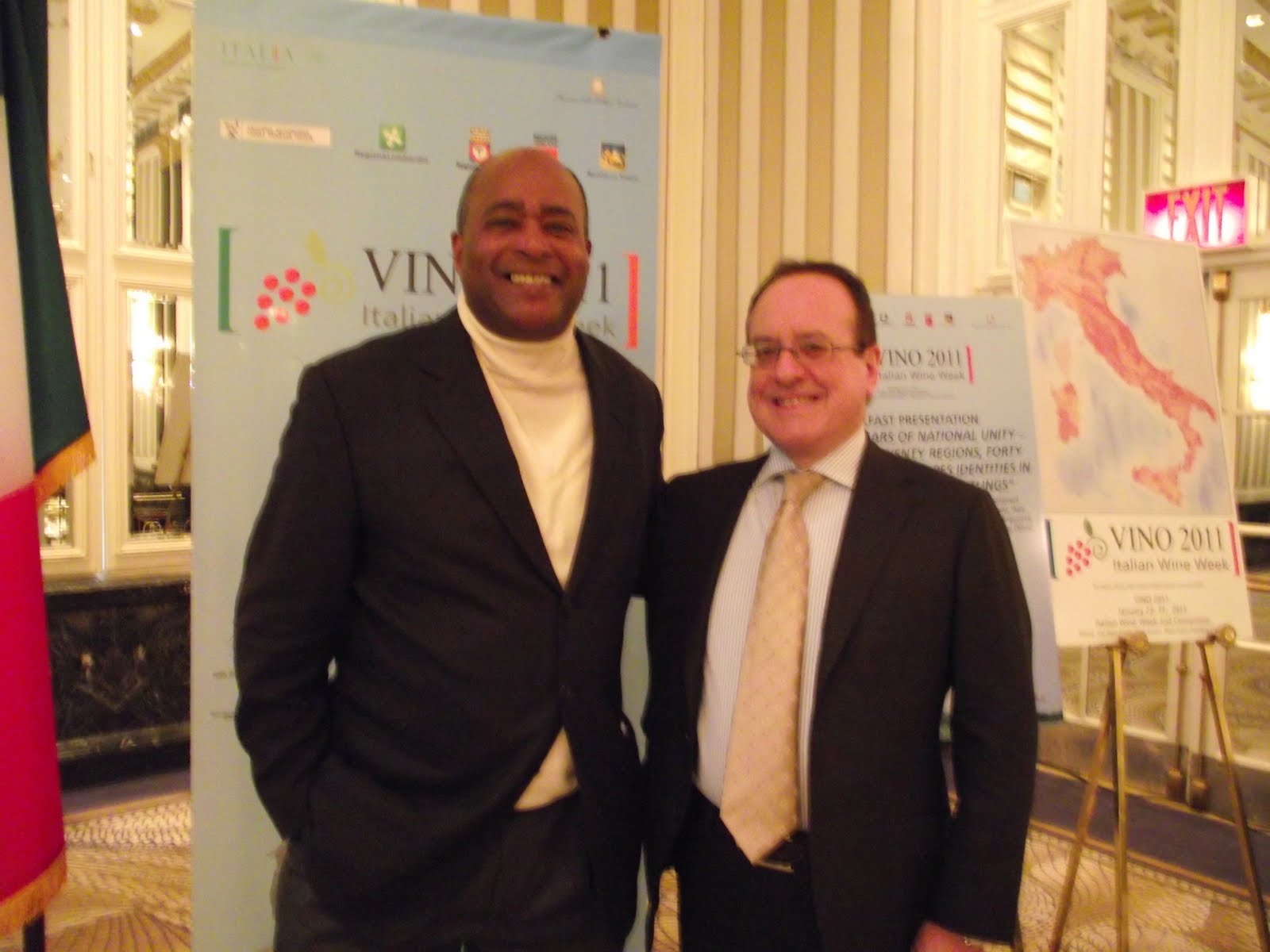
1. Dwight Casimere, Dwight The Wine Doctor, and Giovanni Mantovani, Chairman, VeronaFiere-Vinitaly, Verona, Italy

2. Wine columnist and author Anthony Giglio peruses offerings at Selezione dei Vini di Toscana Awards tasting

3. Tuscan enologist and consulting winemaker Barbara Tamburini addresses the seminar audience at the Vini di Toscana Awards guided tasting

4. Author and Italy for the Gourmet Traveler TV & Radio Commentator, NPR & BBC Fred Plotkin compares notes with Palate Press Editor-In-Chief W.R. Tish

5. The guided tasting for The 2010 Selezione dei Vini di Toscana Awards

6. Lamberto Frescobaldi and Dwight The Wine Doctor

7. Fred Plotkin-Moderator, with panelists Bob Lape, restaurant critic and Ariane Batterberry, Food Arts Magazine at the Seminar "Has the Popularity of la Cucina Italia Surpassed French Cuisine as the Source of Inspiration and Motivation for Future Chefs?" held in the Starlight Roof South, Waldorf-Astoria

8. Giovanni Mantovani-Chairman, VeronaFiere-Vinitaly, Verona, Italy

9. The Buyers & Press Luncheon at the famed Empire Room, Waldorf-Astoria

10. The Waldorf-Astoria, Park Avenue & 49th Streets, New York, New York

New York—The Waldorf-Astoria Hotel in Manhattan was the august scene for the 3rd Annual Italian Wine Week, VINO 2011. Under tight security, the nation’s most sophisticated buyers had an opportunity to mix and mingle with Italy’s Premiere Wine Makers.

Vintners present at the nearly weeklong confab comprised the virtual royalty of Italian winemakers. Regional wine tastings, luncheons and dinners featured wine tastings from the leading regions of Italy, including Apulia, Friuli, Venezia Giulia, Lombardy, Tuscany and Veneto. A focal point was the most comprehensive walk-around tasting of Italian varietals ever experienced in the U.S. The offerings ran the gamut; from award winning wines to old favorites, as well as new and undiscovered brands that came to the event in search of distributors. For a wine lover, journalist and connoisseur such as myself, it was the equivalent of arriving at the Gates of Heaven.

Bracketed by historic winter storms, which extended my stay in New York by several days, the frustration was ameliorated by the knowledge that I had experienced one of the seminal wine events of all time and had an opportunity to rub shoulders with the top names in the industry, both Italian and American.

Seminar topics were pointed and of utmost interest. Topics ranged from “The Future of Italian Wines”, moderated by Elin McCoy if Bloomberg News and featuring remarks by Umberto Vattani, Chairman, Italian Trade Commission-ICE, to “Want to Build a Profitable Italian Wine List? It Pays to Listen to the Pros, featuring panel participants such as Alpana Singh, host of Chicago TVs “Check Please!” and celebrated Wine Director at Chicago’s Everest Room and “Renaissance of the Cocktail in America: Top Spirits Professionals Assess the Role and Opportunities for Italian Spirits,” moderated by Francesco Vallarino Gancia of Southern Wine & Spirits and featured among the panelists esteemed wine writer and author Anthony Dias Blue of Tasting Panel Magazine.

Giovanni Montovani, Chairman, VeronaFiere-Vinitaly, the world’s largest wine exposition that takes place next spring in Verona, Italy, described VINO 2011 as “the most important representation of Italian wine in the United States. The U.S. is our most important export market. Through the years, the consumer here has entrusted us with their confidence by declaring us, through their significant buying power, as the favored wine of all exports. We are showing here that we are not only worthy of that trust, but are making great strides to further improve our product and make available the best wine that Italy has to offer at a fair price. We want to reflect the best quality for the greatest value!”

Women winemakers also made their mark at VINO 2011. Barbara Tamburini, a leading Tuscan enologist and consulting winemaker from Pisa, Italy, was among the panelists at “The 2010 Selezione dei Vini di Toscana Awards” which featured a review and guided tasting of the winners of the recently held 9th edition of the awards, followed by a walk-around tasting of the 30 Tuscan wineries whose wines were selected for excellence by the Region of Tuscany, Italian Trade Commission-ICE.

Among the winners was Lamberto Frescobaldi of Marchesi de’ Frescobaldi, one of Italy’s oldest wineries. With a history dating back to the 1300s, the family has included medieval knights, bankers, lawyers and patrons of the arts. The family tree in Florence almost mirrors that of the Medici’s. Marchesi de’ Frescobaldi is one of the most significant wine producers in Italy, with nine estates and roughly 2,500 acres in Tuscany.

While pouring a glass of his exceptional Frescobaldi

Castiglioni Chianti 2008 ($15.49), Lamberto told me, “This is a great wine event at the beginning of 2011. We are in a fortunate position in that we finished 2010 in a very big way.

“I feel very welcome in this country. I feel comfortable here, not only because of the large Italian-American population, but also because of my personal experience here. I had the honor and the pleasure of studying at U.C. Davis (the University of California’s famed school of Enology at Davis, California, which produced some of the most famous names in California winemaking, including a number of ground-breaking female winemakers such as Zelma Long, formerly of Simi Winery, Sonoma County and the 2010 winner of the esteemed Andre Tchelistcheff “Winemaker of the Year” award at the San Francisco International Wine Competition, Amanda Cramer of Niner Wine Estates in Paso Robles, California).

“The American market has always been very generous to Italian winemakers,” Lamberto continued, while showcasing his newly released Toscana: “Mormoreto” 2006($49.99), a reserve blend of Cabernet Sauvignon, Cabernet Franc and Sangiovese, a spectacular Chianti Rufina that literally explodes with deep, dark fruit flavors, plumy fruit, dried currants and hints of Indian spices. “I feel an obligation to continue to produce wines that are not only pleasant to our American consumers, but better and better every year that we come here.”

From the record-breaking turnout of VINO 2011, in the face of both a daunting world economy and precarious winter weather conditions, it was obvious that Italian winemakers are in for another winning year. For more information on Italian wines, visit www.italianmade.com/vino2011.

Inniskillin Winery: Journey to the "Holy Grail" of Icewine


Story and photos by Dwight Casimere

1. The power and majesty of Niagara Falls
2. Specially commissioned label artwork
3. The view from the Riedel Tasting Room
4. A dazzling array of Inniskillin Icewines presented on the Riedel Room tasting table made of planks from the floor of the Riedel glass factory
5. Inniskillin Winery vineyards
6. The Founding Fathers of Inniskillin Winery with Georg Riedel
7. The trophy case in the Riedel Room
8. Riedel Vinum Extreme glassware
9. Icewine grapes on the vine
10. Deborah L. Pratt, Inniskillin Winery Public Relations Manager at home in the vineyards

Niagara-on-the-Lake, Ontario, Canada—A visit to Inniskillin Wines in this winter wonderland on Canada’s Niagara Peninsula is likened to a pilgrimage to the Holy Grail of Icewine. It is here that two of the founding fathers of Canadian Wine, Karl Kaiser, an Austrian-born chemist, and Donald Ziraldo, a young Italian Canadian agriculture graduate, sought to break new ground by producing premium wine from the grapes developed in the unique growing conditions of the Niagara Peninsula.

Icewine has its roots in Germany and other parts of Europe. In an area like Chicago land, with its large German-American population, memories of the liquid delicacy linger. The popularity of Icewine, and the Inniskillin brand, which is readily available at local fine wine shops, is particularly so during holidays. The approach of Valentine’s Day draws particular attention to Icewine as a seductive gift for a loved one.

On July 31 1975, Inniskillin Wines was incorporated and Kaiser and Ziraldo were granted the first winery license in Ontario, Canada since prohibition. The two quickly dazzled the wine-producing world with their superior winemaking techniques. Their unique approach was embodied in their early mission statement-“Inniskllin: Not so much bound by tradition as inspired by it.”

The first Inniskillin Icewine produced in 1984 had a label that read simply “Eiswen Vidal (Ice Wine). When it was released on December 1, 1985, it retailed for $18. 50.

That inauspicious beginning belies the accolades that later followed. It was the first Canadian wine to win a gold medal at the 1986 InterVin International competition in Toronto. Five years later, the world began beating a path to Inniskillin’s door when, in 1991, it won the prestigious Grand Prix d’ Honneur at Bordeaux’s Vinexpo, the first truly significant international medal won by any Canadian winery.

The final umlaut was achieved when Kaiser joined forces with a fellow Austrian, tenth- generation glass blower Georg Riedel, who created the Vinum Extreme Icewine glass. This unique instrument allows tasters to fully appreciate the subtle characteristics of Icewine.

The Riedel Room is the focus of a behind-the-scenes tasting at the Inniskillin Winery Estate for a small group of visiting U.S. journalists, in town for the Icewine Festival in downtown Niagara-on-the-Lake. Our host, Deborah Pratt is the Winery Public Relations Manager and our tasting guide.

“The first thing to notice is the table where we’ll conduct our tasting. It’s made from the actual floor of the Riedel glass factory.” The wood bears the varicose vein grooves left by the thin, residual stream of hot, molten glass that is the stigmata of the glass blower’s art.

“You’ll notice the difference in the aroma and the taste of the Icewine when you place it in the Riedel glass,” Pratt intoned to the eager gathering. “You can readily see how the Riedel glass focuses the aroma of the wine. You’ll also begin to realize the complexity of its flavors. One of the common misconceptions about Icewine is that it is simply a sweet wine. Because of its acidity, the sugars in the wine are balanced so that they don’t overpower the flavor. What you have is a wine that produces a kind of pucker at the sides of the mouth, which is the experience of the acidity. Then the flavors start to reveal themselves on the tongue and at the back of the throat.”

Icewine is unique in that it stands alone as an aperitif, but it also pairs well with food. A taste of delicious Ermite cheese, a slightly piquant, salty blue-veined Canadian cheese, or a creamy lobe of foie gras reveals a kaleidoscope of flavors inherent in Icewine. Ermite is the Canadian alternative to Danish Blue cheese and is distinctive because of its strong sharp bite, tang and salt qualities. Surprisingly, it is the perfect foil to Icewine, creating a kind of Yin and Yang flavor contrast, not unlike the ‘sweet/sour’ vernacular of Asian cuisine.

“The unique characteristic of Icewine is its naturally high acidity,” Pratt continued, “which is a direct function of its cool-climate viticulture region. Its intense and complex sugars, created by the natural freezing process, make it a unique taste experience and a truly great wine.”

Pratt is uniquely qualified to speak on behalf of Inniskillin wines. She first joined the winery over 30 years ago, trading in a career in teaching to become the winery’s spokesperson, Her unbridled passion for Niagara’s wine and culinary scene has earned her awards recognizing her outstanding contribution to Canada’s wine and tourism industries, including The Ontario Wine Society, Niagara Chapter’s Exceptional Hospitality Award and the Binational Tourism Alliance Summit’s 2008 Women in Tourism Award. She is the creator of the successful “Self-Guided” tour at Inniskillin Niagara.

As Pratt led the tasting experience, it quickly became evident that Icewine varietals have flavors as distinctive as the patterns of individual snowflakes.

Inniskillin Icewine is truly winter’s gift to wine lovers. Harvested at the pinnacle of Canada’s crisp winter, the grapes are naturally frozen on the vine and harvested when the temperature drops well below freezing. Only a few drops of luscious nectar can be squeezed from each bunch. After expertly guiding the precious juice through the fermentation process, it achieves a rich and alluring quality that is enhanced by the experience of drinking it in the Riedel Vinum Extreme Icewine glass.

Inniskillin Vidal Icewine ($66.00 375ML half-bottle) is Oak Aged Gold. Its exquisite fruit flavors, combined with an invigorating acidity offers multiple layers of pleasure that literally dance on the palate. Tropical smells yield to honeycomb and a touch of nutmeg at the back of the throat.

An intermezzo was offered, Inniskillin Sparkling Ice Wine ($69.95 375 ML half-bottle). This is a pure delight that is, understandably, very limited. It is, in a word, sublime. Fresh lime, apricot and grapefruit flavors cascade into a bushel of peach blossoms. There is a scherzo of interplay between sweet and tart flavors with a slight edge of minerality balanced by dried apricots at the back of the throat. The sparkling spritz makes drinking a bracing, vibrant and refreshing experience. It’s an experience that mimics the cascading foam of Niagara Falls.

Inniskillin Cabernet Franc Ice Wine 2007 ($99.99 375 ML half- bottle) is an expressive delicacy that is one of the supreme achievements of the winemaker’s craft. Deep rosewood red in color, it explodes with black currant flavors and a balanced acidity. Its flavors are like the warm kiss of a passionate lover. A hint of African violets greets the nose, and then vanishes. Buy this wine for someone truly special. They’ll never forget you for it. These are just three of the dazzling array of Inniskillin Icewines. For information on more wine varieties, visit www.inniskillin.com.

Thursday, January 27, 2011

Niagara Icewine Festival 2011: Liquid Gold Meets Winter Cold


1. Icewine soaked marshmallow roast at Peller Estates Winery
2. The unofficial "Snow Queen" of the Icewine Festival
3. Hangin' out at the Icewine Festival piano lounge
4. Peller Estates Winery Executive Chef Jason Parsons and his porcine friend
5. Celebrity foodie Steve Dolinsky, ABC7 Chicago's Hungry Hound with Dwight The Wine Doctor. The two were once colleagues at CLTV, Chicagoland Television News


Story and photos by Dwight Casimere

Niagara-on-the-Lake, Ontario, Canada—Icewine is Amazing! Ice wine IS Celebration! Those were the messages that were lasered into my brain like a ray of winter sunlight refracted through the prism of a sculpted ice castle as I strolled through the ice sculptures and tents of the 2011 Niagara Icewine Festival along Main Street in the quaint, movie-set perfect town of Niagara-on-the-Lake.

Twenty-five distinctive producers of the “liquid gold” Icewine that the region is famous for, teamed with the area’s top chefs and food purveyors to create an unparalleled taste experience.

With snow falling gently on the chilly, but sunlit afternoon, foodies enjoyed selections of the area’s best new wine releases and nibbled on the likes of duck chowder, icewine laced meat pies and pulled pork cooked over slow-burning coals in a special box, designed by the team of local winery chef Jason Parsons and celebrity foodie Steve Dolinsky, The Hungry Hound of ABC7 Chicago.

“We take a whole baby pig and rub it down with a secret blend of herbs and spices and let it marinate overnight. Then we completely submerge it in the hot coals in this special box and cook it for 6-8 hours. The meat comes out so tender that it almost shreds on it’s own. We serve it in a special sauce that’s been simmered with Peller Estates Vidal Icewine, Served on a soft egg bun. It’s flavor fireworks exploding in your mouth!”

As embers of the day faded behind a veil of clouds over the snow covered vineyards, the afterglow of the day was spent leaning over an open fire at Peller Estates, roasting homemade marshmallows that had been soaked in Icewine. The taste was so seductive that I gorged myself with abandon, oblivious to the tongue-scorching heat of the marshmallow, the smoldering embers still clinging to its singed, caramelized surface. I felt and looked like a kid, with sinewy strings of the gooey mass on my mouth and chin. It was a marvelous, sweet finish to a cold, but soul-warming day.

Monday, January 24, 2011

Wine Country Ontario warms the heart and hearth with Icewine


1. Dwight The Wine Doctor with winemaker and owner Klaus Reif of Reif Estate Winery

2. Formula for Icewine making carved into top of ancient fermentation tank

3. Reif Sommelier and Wine Club Manager Archie Hood

4. Icewine vineyard at Reif Estate Winery

5. The splendor of Niagara Falls

Story and Photos by Dwight Casimere

Niagara-on-the-Lake, Ontario, Canada—Niagara Falls is one of the magnificent wonders of the world. Its thundering waters fuel an enduring tourism industry in this splendid winter wonderland on the outskirts of the city of Toronto. Its rushing waters provide power, via an intricate network of hydroelectric dams. Its rivers, lakes and tributaries also are a source of scenic pleasure, water-borne recreation, sport fishing and provide a romantic backdrop for marriage proposals and weddings.

There is another attraction that has been looming on the horizon for the past several decades that is little known, and that is Icewine. Ontario, Canada is the world leader of this liquid gold delicacy. Canada’s cold temperatures, rocky soil and vast terrain provide the perfect conditions to grow the grapes that can be turned by master alchemist winemakers into this rare treat.

In celebration of the Icewine experience, the Wine Council of Ontario is leading an initiative for “Wine Country Ontario” in partnership with OTMPC (Ontario Tourism Marketing Partnership Corporation). Icewine Festival 2011 is the manifestation of that effort to present the Niagara Wine & Culinary Experience. Main Street is turned into a winter wonderland, complete with ice sculptures, festive tents filled with delectable treats prepared by local chefs from locally sourced meats, cheeses and produce and, of course, Icewine. An open-air pig roast, hosted by Chef Jason Parsons of Peller Winery and an Icewine Cocktail Competition judged by Chicago Foodie Steve Dolinsky of ABC7-TV Chicago, The Hungry Hound, is one of the highlights of the festival.

Celebrated winemaker Klaus W. Reif hosted a behind-the-scenes tour of his Reif Estate Winery at his lush 125-acre estate. Featuring a 20-year-old block of Vidal grapes, still used today in the production of his internationally acclaimed Vidal Icewine, which was praised by Wine Spectator Magazine in 2008 as “racy and electric, like a laser beam of dried apricot and citrus.”

“My family has been making Icewine in Germany for the past 300 years. I am the 13th generation of my family to be involved in winemaking, which began in Neustadt, Germany.”

In 1977, Klaus’ uncle, Ewald Reif arrived in Canada and purchase 80 acres of farmland, which he turned into the winery’s first vineyards. The following year, Klaus and his father arrived in Canada and fell in love with the land and its people. They obtained a winery license in 1983, opened a retail store in 1987 and the rest, as they say, is winemaking history.

Klaus began the art of winemaking at his father’s side as early as eight years old. In the cellars, he points proudly to an inscription of the formula for making icewine, carved into the top of an ancient fermentation tank. It remains today, the Talmudic inscription for the creation of Icewine.

“Right now, Korea and China are our largest customers, but we are looking forward to expanding our popularity in the United States.”

Icewine is primarily enjoyed as an aperitif or dessert wine, but a visit to the Reif tasting room and an informative taste exploration with Reif Sommelier and Wine Club Manager Archie Hood quickly dispelled any misconceptions about Icewine.

“Most people think of Icewine and one dimensional and sweet, but if you examine the flavor profile and allow yourself to experience the wine in your mouth and on your palate, and if you have it with some food, you’ll quickly learn that Icewine, particularly the aged wines, are versatile and complimentary to all types of food.”

I tried the wines with an assortment of local delicacies; 2008 Riesling Icewine form the Niagara River ($26.95/200 ml) paired with Butternut Squash Soup.

“We pick our grapes at night,” Klaus explained in an informal interview in his upstairs private tasting room, against the backdrop of a roaring fire. “We started picking the grapes in December, just after I had gotten back from China. I’ll never forget it, because the temperature made it possible to harvest our vinifera Icewine grapes, which are more tender and delicate as compared with the thicker-skinned Vidal grapes. This 100% Riesling was harvested from one of our oldest vineyard blocks. The flavors and aromas attest to its uniqueness, clarity and elegant honeyed highlights.”

Archie Hood further rhapsodized about the wines as he conducted the tasting experience. “You can tell when you’ve had a truly great tasting experience which you can identify that third taste element. It’s not always apparent when you first pair the wine with food. It’s something that comes afterward, because it’s hidden. ”

In the case of 2008 Vidal Icewine ($46.95/375 mill) paired with Duck Terrine, it was the taste of nutmeg, which gave the duck a gamey flavor, much like that of venison.

2005 Vidal Icewine ($56.95) paired with Ermite Blue Cheese revealed layers of dried fig, Maple syrup and toffee that brought out the pungent aroma and toffee and almond flavors that delicately balance this wine. Dessert was the crowning experience with 2008 cabernet Franc Icewine ($29.95/200 ml) paired with Strawberry Truffle.

I was to later experience a cavalcade of Niagara River wines with the sumptuous cuisine of Executive Chef William Brunyansky over a dinner consisting of local ingredients paired with wines of the region, some featuring Icewine in the preparation at the Charles Inn, one of Niagara’s Finest Inns. I also had the pleasure of staying at the quaint lakeside Harbour House.

As the day broke over Niagara-on-the-Lake and a spectacular ruby-red glow spread across the morning sky, I bit into a crunchy house-made dinner roll I had purloined from the Charles Inn dinner the night before, and took a sip of coffee that I had laced with a generous pour of Vidal oak aged Icewine. This was the day of the Icewine Festival, I had already fortified myself with the internal embers that would warm me as I made my way through the festival tents and their bars made of ice.

Monday, January 17, 2011

Arrington Vineyards: French-style wine in Tennessee Whisky country


1. Sunset over Arrington Vineyards in Tennessee
2. Arrington's Award-winning Chardonnay
3. An American Oak aging cask
4. Tasting room at Arrington Vineyards
5. lush picnic grounds overlooking the vineyards at Arrington


Story and photos by Dwight Casimere

NASHVILLE—Tennessee is known for its whisky and Nashville, in particular, is known as the world capitol of Country Music.

Country Music Hall of Fame singer Kix Brooks has taken a detour with the establishment of Arrington Vineyards outside Nashville. Brooks as part of the hit-making duo Brooks and Dunn, has won more Country Music and Academy of Country Music awards than any act in the history of country music. After 20 years, the two have sold more than 30 million records and are currently completing a farewell tour. Brooks hopes to garner accolades following his retirement from his music career in another career, under the title of winery owner. Early indications are that Brooks, his business partner Fred Mindermann and winemaker Kip Summers, are well on their way to making winemaking history.

They’ve managed to turn Kix’s dream of creating world-class wines in Tennessee into a reality, winning “Best of Show” at the Wines of the South competition for its Syrah in 2007 and quickly selling out its early vintages. The wines are slowly rolling out across the country, starting with fine wine shops in New York City and New Orleans and even expanding to stores in a competing wine growing region, Oregon. With the addition of businessman John Russell to the Arrington Vineyards management team, the winery hopes to expand the label into a national recognized brand in major wine-consuming cities, including the Chicago area.

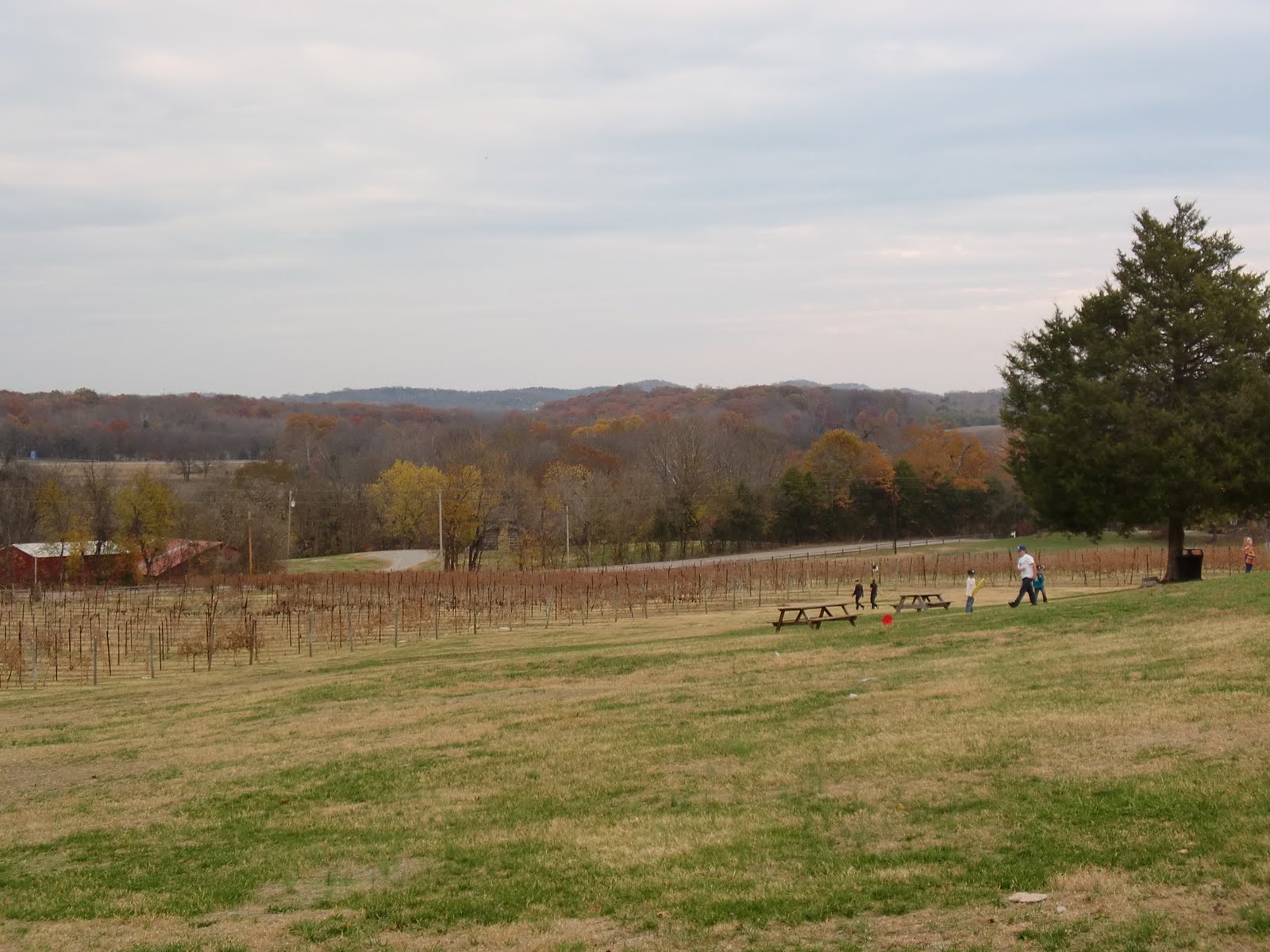
The grounds of Arrington Vineyards are nestled in the rolling hills outside Nashville. On a typical weekend evening, the winery and its cozy tasting room, retail store and inviting patio and picnic grounds, are a favored destination for tourists. They stop in the tasting room, enjoy a ‘flight’ of Arrington’s signature wines, then purchase a bottle and some local cheeses and smoked meats from the retail store and enjoy a picnic overlooking the lush vineyards. The winery also hosts a popular concert series, Music in the Vines, which attracts lovers of instrumental jazz music. Visitors are invited to bring blankets and chairs and relax and drink wine to the music as they watch the sun set over the rolling hills. There could not be a more idyllic scene.

The wines are all reasonably priced in the $20-$30 range. They offer a terrific value in terms of flavor and sophistication for the money. I was, in fact, delightfully surprised by the quality of the wines.

The 2009 Chardonnay ($21.99) had a delightful pineapple and apple pie nose that lead to some mouth-watering flavors of tangerine and apple. A hint of vanilla and smoky oak on the finish attested to aging in oak barrels. The award-winning Syrah 2008 ($27.99), is truly a standout. I could readily see why it won accolades. It’s a rich, aromatic wine with aromas and flavors of blackberries, raspberries, cloves and cocoa. Eighteen months of aging in American oak gives it complexity, making it the perfect accompaniment to grilled beef tenderloin or braised short ribs. I had it with some terrific locally raised cheeses and fresh baked bread and was instantly transported to nirvana.

My other favorite was the 2009 Viognier ($19.99), a really glamorous wine brimming with floral aromas and peach and honey flavors backed by some nicely tart nectarines and melons. This wine took Silver at last years’ Wines of the South competition and a Bronze at last year’s Indy International Wine Competition. Without even knowing that, I was certain that it had garnered awards!

This is a full-tile Rhone Valley styled wine that, in fact, uses Rhone 4600 yeast in the fermentation process, giving it full tilt Viognier flavor. Muscat Blanc (13%) is added to give it some aromatic complexity. Winemaker Kip Summers truly showed his finesse by aging the wine strictly in stainless steel tanks to preserve the full richness of its glorious fruit.

Tennessee countryside, particularly outside Nashville, is among the most picturesque anywhere in the United States. The addition of Arrington Vineyards to this rich landscape makes the area a destination well worth consideration in your future travel plans.

Thursday, January 13, 2011

TRAVEL: Tennessee Civil War Trails of blood, glory and angst 150 years later


1. Lookout Mountain-a strategic stronghold during the Civil War
2. Honest Abe at the Tennessee Sesquicentennial Signature Event in Nashville
3. Stones River National Battlefield
4. Chief Ranger Gib Backlund of Stones River
5. "The Widow of the South"
6. Free Blacks fought on both sides of the Civil War
7. An infantryman's view of the Civil War
8. A Confederate Officer
9. Monuments at Chickamauga and Chattanooga National Military Park
10. New York Times Best Selling Author Robert Hicks, "The Widow of the South" with Dwight The Wine Doctor

Story and photos by Dwight Casimere

One hundred and fifty years later, and the scars from wounds of the Civil War still run deep and are red with fresh blood. Just listen to the words of Country music star and Grand Ole Opry member Trace Adkins at the State of Tennessee’s Signature Event for the state’s Civil War Sesquicentennial Celebration, held in Nashville last November. Just moments after congratulating the all-black Fisk Jubilee Singers of Fisk University, on their stellar performance, Adkins, a former Gospel singer himself, launched into this perfunctory diatribe:

“Over the generations it has seemed to me that Southern children, because of that terrible slavery issue, have been made to feel apologetic — if not guilty or ashamed — of their heritage,” Adkins told the audience at the Tennessee Performing Arts Center in Nashville.

“And I for one hope my children don’t feel that way, because everybody knows or should know that the majority of soldiers that fought for the Confederacy did not own slaves. I know that my grandfather didn’t, and had no aspirations of owning slaves. It wasn’t part of his makeup.”

“The main issue” that motivated the South to resist the North, was states’ rights. That’s what my grandfather told me — that that’s the reason why his grandfather went to war in the first place,” said Adkins.

Furthermore, he added, while the issues of slavery and secession from the Union may have been “settled” by the war, fundamental questions about what role the states have in plotting their own political destinies were not resolved. Had they been, “we wouldn’t still be arguing about it today,” said Adkins.

Adkins also revealed — for the first time in public, he said — that as a statement of allegiance to states’ rights and tribute to the men of the Confederacy who fought to defend the concept, he refuses to cut his hair.

“I’ve had a lot of people over the years ask me, ‘Why’s your hair so long?,’ The answer to that question is, towards the end of the war when the outcome was obvious to everybody, there were a group of incredibly dedicated Confederate soldiers who said, ‘For me this issue is not settled, and until the issue is settled, I’m not going to cut my hair.’ Neither will I.”

Adkins’ statement was at first met with stunned silence, then restrained, polite applause as he strode silently offstage. While he may have sealed his fate as a spokesperson at any future Sesquicentennial celebrations, I’m sure he spoke for many who share his feelings.

Adkin’s statements may have been blunt, even unsavory to some, but they mark the deep divisions that still remain 150 years later. Such was the temperament of discovery and discussion as I embarked on the Tennessee Department of Tourist Development’s preview tour of Tennessee Civil War Trails and Byways in advance of the state’s five-year commemoration of the 150th Anniversary of the Civil War.

The Civil War remains the bloodiest war in modern history with more casualties than both World Wars, Viet Nam, Korea, Iran, Iraq and Afghanistan combined. The official numbers stretch into the millions with the number of civilian casualties and the number of maimed and wounded beyond any useful or productive life, still uncounted.

“Brother fought against brother,” New York Times Best-Selling Author Robert Hicks, of "The Widow of the South," told a hushed dinner gathering at Lotz House, one of the scenes of a bloody Civil War battle in Franklin, Tennessee. The walls of the otherwise pristine mansion are still pockmarked by the shells and cannonballs of that horrendous night. The Lotz family was forced to seek shelter in the basement of the Carter House, across the street, while their beautiful home was scarred with cannon fire. “Soldier’s diaries tell many stories of how they traded shoe laces, songs, stories, cigarettes and whiskey across enemy lines in the darkness of night only to fight each other to the death once the sun rose at dawn.”

The most chilling moments came as our tour approached the Carnton Plantation, home of Carrie McGavock, The Widow of the South. As our group approached the imposing, white columned structure under an especially clear, starry nighttime sky, it was hard to image that the 48 acre plantation home served as the field hospital and final burial place for nearly 1,500 Confederate soldiers who were killed in the Battle of Franklin. There were still visible signs of the blood that was shed on the upper floors of the mansion. One of the upper rooms, where an imposing portrait of McGavock dominates the expanse of one wall, in fact served as the main ‘hospital’ room where McGavock herself helped to tend to the wounded and dying. She and her family later buried many of the dead on their plantation.

Public schools euphemistically refer to the Civil War as “the battle between the states” giving little weight or credence to the fact that the war was fought over one simple economic and social reality-slavery. “The central issue of the Civil War was slavery. Pure and simple!” asserted National Park Service Ranger James H. Ogden at the outset of a tour of the Chickamauga and Chattanooga National Military Park. “What was at stake was a $4 billion dollar industry, an amount that is staggering, even by today’s standards. It certainly was so, then.

“In many respects, even those that were being held in servitude were conflicted over the progress and outcome of the war. What you never hear about in the lectures and literature on the Civil War is the “shadow army” of slaves who followed their masters into battle and provided all of the goods and services and support functions for the war. When the soldiers went to war, they followed them into battle. When they went home, the slaves also went home. In many respects, their fate was in the hands of the men who fought on the Confederate side. There was no real assurance that the Union Army would do anything to help them or their families once the war was over. In fact, there are horror stories regarding the conduct of the war on the Union side, that are quite the contrary.” One such story gives a chilling account of how Union soldiers abandoned an entire regiment of black support troops on the banks of the Tennessee River just as Confederate troops were bearing down on them. The black soldiers, who could not swim, drowned trying to flee the advancing onslaught while the white Union soldiers sailed away to safety.

A visit to Stones River National Battlefield outside Nashville brought the horror and human cost of the war front and center. Along one side of the highway leading to the park entrance is the sight of thousands of crumbling, white grave markers, denoting the final resting place of the soldiers who perished in one of the bloodiest battles fought in the state. “I’m sure you’ve heard countless times in your travels that ‘this is the most decisive battle of the Civil War’ and ‘this battle marked the turning point’ in the war, “ said Chief Ranger Gib Backlund. “In some respects, they’re all correct. When you look out over the vast expanse of this battlefield and then let your eyes wander over to the sight of that cemetery, you get a very clear picture of the human cost of this war. In many ways,” Backlund said, “the battle here re-established Northern morale and paved the way for the Battle of Franklin,” which marked the emotional turning point in the war. “It became crystal clear that the South and the Confederacy were fighting a losing battle.”

The most chilling and emotional moments of the tour came during visits to the homes and plantations of ordinary citizens. The streets of Franklin, Tennessee, for example, became the scene of a gruesome guerilla war that was witnessed by families cowering in their basements. “We forget while looking backward through the telescope of history that, in many cases, these were just ordinary people whose primary concern was the safety and well-being of their families. In the instance of Franklin, they found themselves in the midst of one of the most horrific chapters in the progress of the Civil War.”Author Hicks summarized.

For more information on Civil War Trails and the Tennessee Civil War Sesquicentennial, visit their website at www.tncivilwar150.com.

Tuesday, January 11, 2011

Hearst Ranch Winery:a regal wine rises in shadow of Hearst Castle


1. Rear view Hearst Castle
2. Hearst Ranch Manager
3. Detail over fireplace at Hearst Ranch
4. Hearst Ranch Lone Tree Cabernet Franc 2007
5. Dwight The Wine Doctor with Steve Hearst

Story and photos by Dwight Casimere

San Simeon, Calif.—Hearst Castle rises majestically above the clouds overlooking the dramatic outline of the Central Coast of California. The view from the Neptune Pool is glorious as golden rays of sunlight dart through the mist to reveal the azure Pacific and the vast expanse of rolling hills below.

The Hearst estate is maintained as a state historic park that is listed as a National Historic Landmark. Far below the castle and its considerable collection of Florentine art, antiques and artifacts, lies the largest beef cattle operation in San Luis Obispo County. Hearst Ranch is operated by Steve Hearst, the great-grandson of William Randolph Hearst. About a year ago, he started the Hearst Ranch winery, with a tasting room virtually in the shadow of the Hearst Castle.

A vice president of the Hearst Corporation, Steve manages the family’s vast commercial real estate, timber and property operations in addition to the extensive ranch, which includes both cattle and Bison, and now, the wine venture, which is a first.

The winery’s tasting room is just across Highway 1 from the Hearst Castle Visitor Center inside historic Sebastian General Store.

A recent visit to the Hearst Ranch took Dwight The Wine Doctor to the private dining hall of the Family Ranch to meet with Steve Hearst and talk to him about the impetus behind the wine over a lunch of his estate grown, grass-fed beef.

The building was a far cry from the opulence of the Hearst Castle. In fact, it’s a rather unassuming structure, resembling a “long barn” normally used to house and feed cattle ranchers. A huge fireplace at one end of the room prominently displays the antelope and Angus steer that dominate the vast property. A long, wooden bar on one side of the room is topped by several bottles of the newest wine releases and rows of glasses. Tables are set in the huge beam-ceilinged dining room for the afternoon repast of Angus beef hamburgers grilling on the open fire outside.

“We don’t grow anything here in the way of grapes or produce any wine here. All that is contracted out to someone I really know and trust, Jim Saunders of Saunders Vineyard in Paso Robles. We must’ve tasted about a hundred different wines and blends before we decided on the ones that would best represent what we’re trying to do. This isn’t just a vanity label. We’re really aiming to produce premium, wine that will proudly represent the region.”

Early indications are that the first effort has been a success. Critics have greeted the wine with accolades. An informal tasting bore out their enthusiasm over the inaugural vintages.

Grapes are hand-harvested at Saunders vineyard in Paso Robles. Wines embody the full, rich flavor of the grape varietals from which the are derived. Chardonnay, Cabernet Saubignon, Cabernet Franc, Merlot, late Harvest Zinfandel and a Reserve Cuvee Blend, give full expression to the flavors and hues of the Central Valley.

“The back story is Saunders purchased a ranch tour at a cancer fundraiser last year,” Hearst said. “We realized we shared views on sustainable agriculture and ultimately decided to do this project together.”

“We have become quick and high-quality friends. He is a real dynamo,” Hearst added. “I think we complement each other’s businesses. It was a lot of fun putting it together.”

Jim Saunders is in complete control of the winemaking operation. He has collected the grapes from several vineyards in the Paso Robles area, including his own and will process and bottle the wine at his winemaking facility. Adam Lazarre is winemaker. He is also the winemaker for San Miguel’s Villa San-Juliette, which produces about 35,000 cases and is owned by “American Idol” producers Nigel Lythgoe and Ken Warwick.

The Hearst Ranch wines sell for between $25 and $70 a bottle.

Hearst Ranch 2007 Lone Tree Cabernet Franc($28) took the Gold Medal and Chairman’s Best of Class Distinction at the Long Beach Grand Cru, one of the world’s top wine judging events, besting more than 1400 wines that were entered.

This is a truly delicious and approachable wine with a complex, rich flavor profile that far outpaces its moderate price. A classic aroma of crushed black pepper and red currant dominates the nose. Layers of cocoa and lush, red fruit and berry flavors dance on the tongue. This is a great wine for grilled meats, particularly a hearty cut of Prime, aged beef. (Hearst’s magnificent grass fed beef is available online, by the way, and can be shipped anywhere in the country. The wine can also be ordered online.) I recently encountered a relatively new cut of beef for Chicago, which is quite common in California, the Beef Tri-tip. Its similar in texture and flavor to top sirloin, but has a slightly coarser grain and a bit more heft in the flavor department. The recipe Hearst Ranch Tri-tip calls for a rich seasoning of herbs, red chili flakes and olive oil, served with a spicy Italian Peppronata sauce. Here’s the recipe from Chef Chris Kobayashi at Artisan Restaurant, Paso Robles:

Charcoal Grilled Hearst Ranch Tri-tip with Peppronata Artisan Restaurant - Paso Robles, CA

Chef Chris Kobayashi

Artisan Restaurant

1401 Park Street

Paso Robles, CA, 93446

www.artisanpasorobles.com

Wine: 2007 "Lone Tree" Cabernet Franc

For the Tri-tip

1

Each

Two to three pound Hearst Ranch Tri-tip

1

Tbls

Fresh thyme, chopped

1

Tbls

Fresh rosemary, chopped

1

Tbls

Fresh oregano, chopped

2

Tbls

Extra virgin olive oil

1

Tbls

Red chili flakes

Salt and pepper

1

Bunch

Arugula

Lemon and olive oil for dressing

For the Peppronata

8

Each

Gypsy Peppers

½

Cup

Extra virgin olive oil

2

Tbls

Salt packed capers, rinsed and drained

½

Cup

Peeled seeded diced tomato

1

Cup

Diced red onion

1

Clove

Garlic, thinly sliced

1

Pinch

Red chili flakes

¼

Cup

Castelvetrano olives, or another Italian green olive, pitted and chopped

2

Tbls

Red wine vinegar

Salt

Special Note: Purchase Hearst Ranch Tri-tip at www.hearstranch.com.

For more on Hearst Ranch Wines, visit www.hearstranchwinery.com.